
The Carnivore of Eden
Originally published in Panorama: The Journal of Travel, Place, and Nature
*
Originally published in Panorama: The Journal of Travel, Place, and Nature *
Although it can be found in garden centers across the world, the natural habitat of the legendary Venus flytrap is restricted to a meager seventy-mile swathe of the Carolinas. This swathe includes the Green Swamp Preserve, located ten minutes from my in-laws’ house. A visit to the preserve reveals a highly specialized ecosystem, dependent on the careful duet of periodic controlled burns and spells of moisture retention. Here, the landscape is dominated by ancient longleaf pines, which can live for centuries, growing up to one hundred feet tall, as well as their partners, the shrubby pocosin bogs, whose comparatively transient existence fluctuates with the rains. Strange places are, of course, home to strange creatures. The red-cockaded woodpecker, Bachman’s sparrow, Hessel’s hairstreak butterfly, American alligator, and black bear all call this preserve home. But at Green Swamp, flora steals the show. There are sixteen species of native orchids and fourteen species of carnivorous plants, including bladderworts, butterworts, sundews, four species of pitcher plants, and the main attraction, the Venus flytrap.
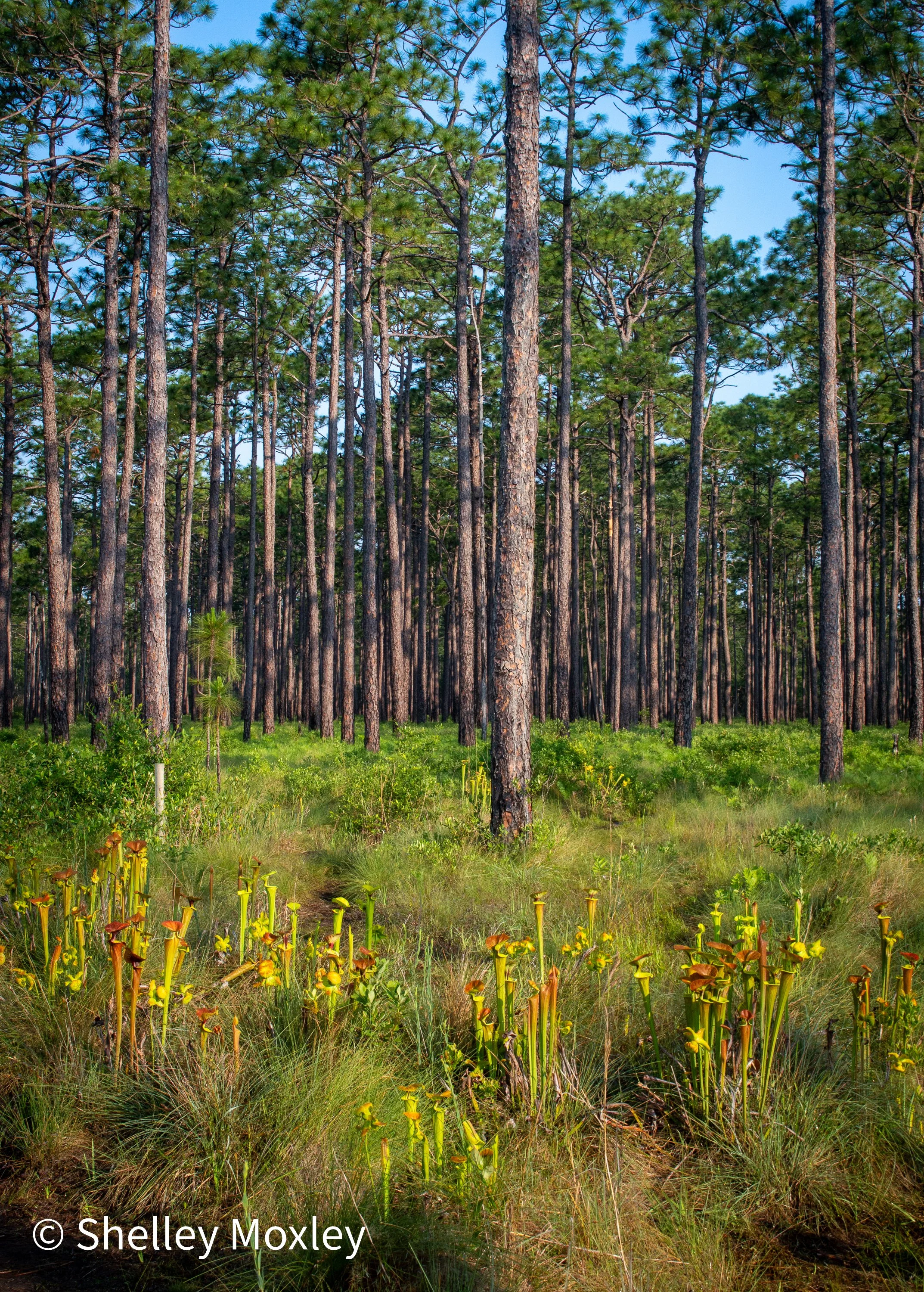
Pitcher plants grow alongside longleaf pines at the Green Swamp Preserve.
At Green Swamp, the earth itself is to blame for the plant kingdom’s mad descent into carnivory. The soil is stripped and leached, clogged by peat and diluted by rainwater, distilled down to dust, to something more memory than matter. While photosynthesis keeps the flytrap alive and its roots keep it anchored, neither provides nitrogen, which the plant needs to proliferate. A plant without proliferation loses, given enough time. And a loser will try anything once.
After only a few hours in the swamp, I start to feel it too: an uneasy desperation that builds in the dense, wet air. There is a sense of pushing toward an unknown culmination. Something is going to happen. In June, heat is high and humidity is oppressive. Mosquitos are undeterred by the usual barriers as they feast on my blood through repellent-soaked clothing. Anything will eat anything. At first, I keep my hands near my face as I walk, waving away the swarm of gnats. But after an hour of this, I scream at them to leave me alone, and when they don’t, I give in, resign myself to their constant, infuriating hum. I’m up to my ankles in mud, then to my calves. Each step is exhausting. The buzz of the gnats changes. Its pitch becomes higher, faster, more urgent. The half bottle of water I brought is depleted. The red-cockaded woodpecker calls again, and I laugh with derision; what was once a beacon is now a taunt. Its call echoes through the trunks of the identical longleaf pines, which spiral out in every direction. I stop to rest near a group of flytraps, and I think I understand. Once you’re desperate enough, it would be so easy, in this place, to snap.
But the flytrap didn’t just go insane. Its predation of insects solves its proliferation problem with tidy practicality–on average, insects are about 10% nitrogen by weight. A gnat is a feast. There’s a reason it didn’t evolve to eat mice or birds or snakes. To lure its prey, the flytrap secretes a fragrant nectar, which slicks the surface of the plant’s trap, a bivalved mouth attached to the base of the plant by a short stalk and bordered by delicate sensory hairs. Insects drawn to the scent of the nectar set off the trap by touching multiple hairs, or the same hair twice, within twenty seconds. We know timing is everything in the swamp. But we don’t know how the plant keeps count.
The slightest changes in pressure are detected by the sensory hairs as the insect moves. The trap snaps shut in about a fifth of a second–and in a kingdom that prioritizes growth over motion, this is one of the fastest movements on record. Closure of the trap won’t initiate digestion. A swamp is full of false positives, and digestion is costly. To avoid digesting a raindrop, or a leaf, or a breeze, the plant waits for prolonged detection of the frantic beat of tiny feet against the walls of its trap. Only then does the trap seal tightly and release a cocktail of powerful digestive enzymes far more complex than human stomach pepsin. Over several days, the insect’s body is chemically dismantled, molecule by molecule, until only a broth of nitrogen and other stolen nutrients remains. The patient plant eats its fill.
When the trap reopens five to twelve days later, only a few fragments of the meal remain–a shard of wing, a single bent leg, a crumb of exoskeleton. The rest has been absorbed. Each trap is fleeting, good for only three to five meals before mechanical fatigue and enzymatic stress render it unusable. The trap then withers on its stalk, and the plant draws from its replenished nitrogen reserves to build another. I struggle with this math. Sixty-five million years of evolution, and a trap isn’t even a permanent fixture. The energetic cost of building a new trap–all that new growth, the architecture and chemistry and nutrients it requires–must be immense. And for what. Three to five uses per trap seems impossibly inefficient. I search for specific numbers and come up empty. The studies just aren’t there. We don’t know what it costs the plant to build a new trap. We don’t know the price of nectar, the toll of a false alarm, the exchange rate of an average meal. We can only infer. A single beetle must be Thanksgiving, or the whole system would collapse. Somehow, in this place, it adds up.
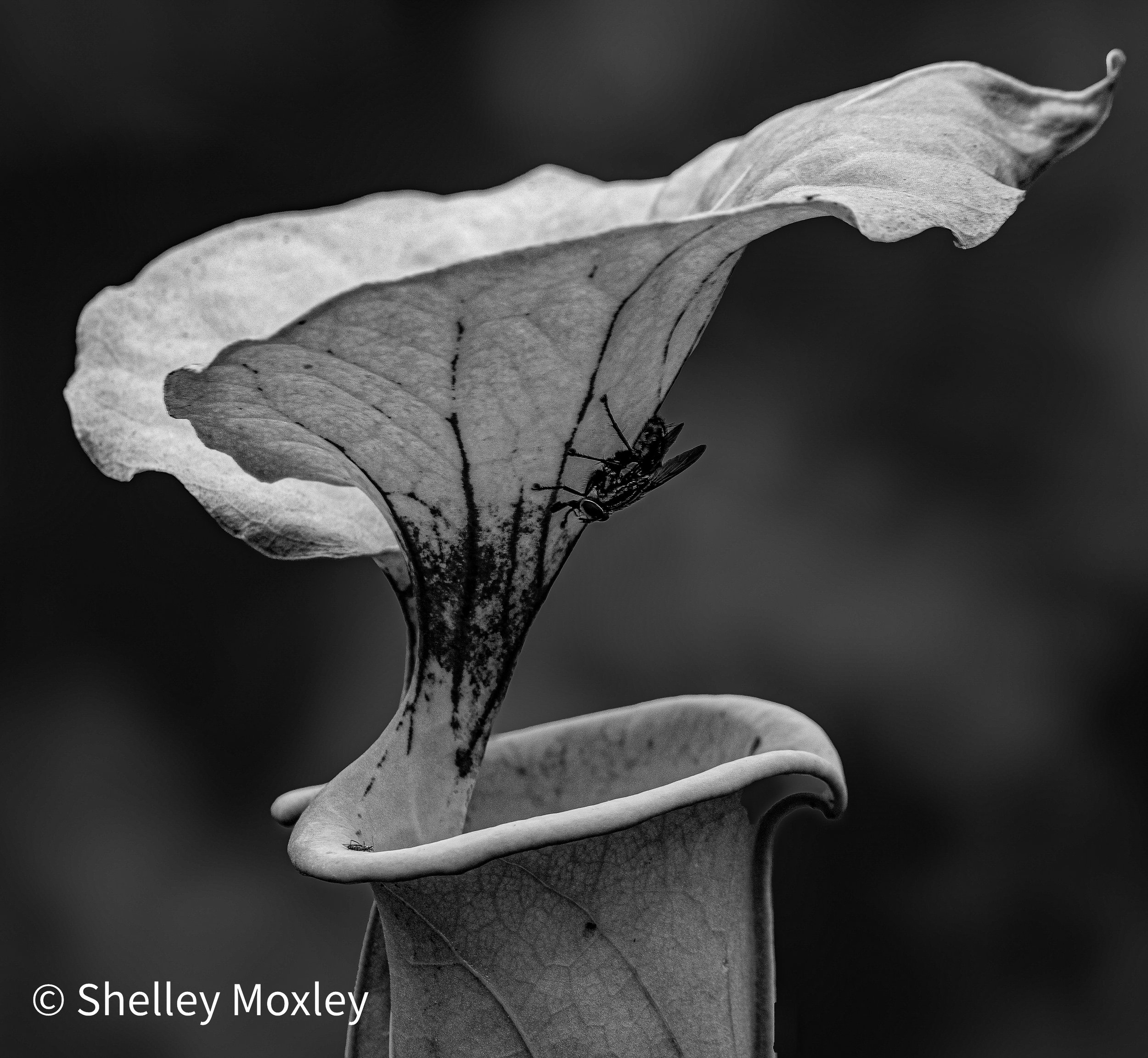
A fly descends into a pitcher plant.
Despite its incredible adaptations, the Venus flytrap is a species in decline, largely due to poaching and habitat loss, challenges it has not yet evolved to overcome. Give it a few million more years and it might change its size, its reproduction strategy, its shape. But then again, it might not. It might run out of time. Posted signs at Green Swamp warn against illegal harvest of the flytrap, which grows in the open, along the main trail, where it thrives without competition from taller plants. In June when I visit, the flytrap is in bloom. The cap of its tall central stem is crowned with clusters of small, white petals. A quick scan of the trail reveals hundreds of flowers–it’s difficult to imagine the species as vulnerable, until you consider that there were once thousands in the same patch of forest.
How is it that a highly protected species, struggling to grow even in its precise environment, can be purchased at garden centers, or even online through Etsy or Amazon? I’ve both given and received flytraps as gifts. My coworker once brought one in for the whole office to enjoy. I must have had a dozen as a child. This dissonance becomes stranger still when I realize I don’t know anyone who’s kept one alive, myself included. A plant with such a narrow ecological niche is almost certain to fail in a planter. And once resigned to a spidery windowsill by an impatient caretaker, it becomes nothing more than a temporary novelty, destined to wither and die.
As it turns out, most commercially available Venus flytraps are propagated in production labs under controlled, swamp-like conditions, a capitalist workaround designed to ease pressure on wild populations. A cutting from the plant is grown in a Petri dish, placed in an incubator that controls moisture, temperature, light, and pH. There are no early frosts, no blights, no tourists. Much of the flytrap’s nutrients, including nitrogen, can be provided in culture media, or even in ground insect powder. Live insects are rare in sterile environments, so in order to stimulate natural feeding responses, commercial flytraps may receive dead insects. The stimuli detected by wild flytraps preying on live insects must be faked: tweezers or toothpicks are used to tickle sensory hairs, and a quick massage of the closed trap can simulate enough movement to initiate digestion. If all of this feels cheap, that’s because it is. For under twenty dollars, our green monster can have its fly and eat it too.
The irony of this is not lost on me, and yet, this swamp is the birthplace of paradox, of nuance, of contradiction. It is both bold and vulnerable, generous and cruel, calculated and spontaneous. Deep within the swamp, brutality and beauty, in particular, coexist with perfect balance. There’s not an intact organism to be found. Dragonflies lack wings, orchids cling to doilied leaves, longleaf pines keel, their trunks blackened by smoke. My own visit leaves me with over one hundred mosquito bites, almost exactly the number of incredible photos I take with my camera. This is the cost of admission, see, nothing is free. And yet the place is alive–thriving even–the entire landscape sparking with creativity: for every species that masters a miraculous adaptation, both its predator and prey respond with something even more clever. There is no limit to how far the swamp will go, no way to guess what’s next. So for now, I watch, and I wait, and I brace myself for the next horror.
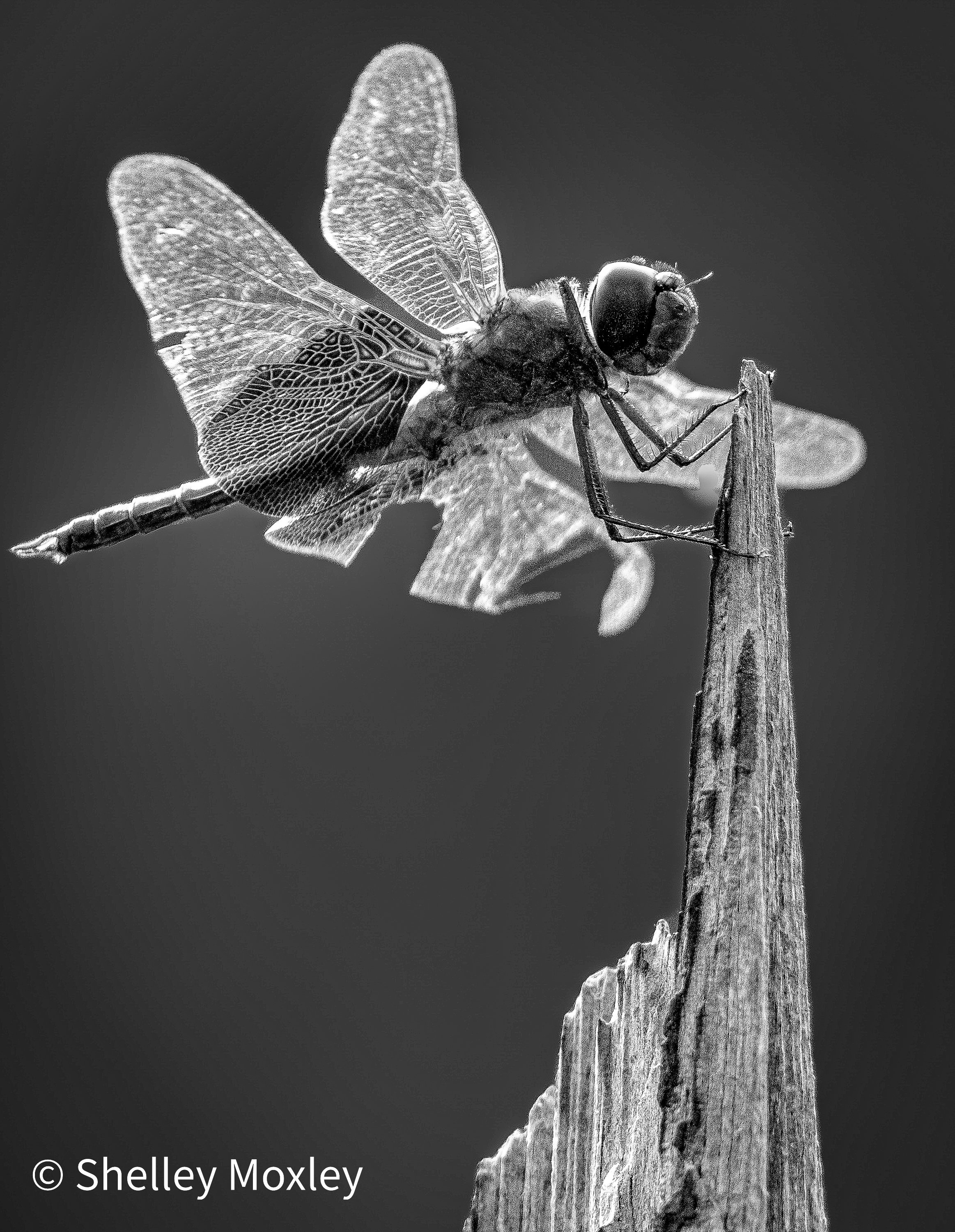
A Carolina Saddlebags holds on for dear life.
